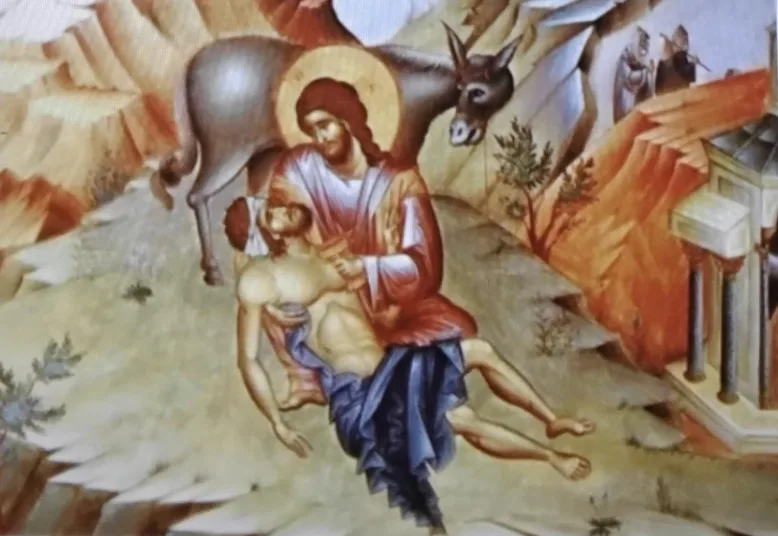
THE GOOD SAMARITAN.
“The virtues build a new person radiating love to the world.”
(Metropolitan Paul (Yazigi) of Aleppo who consecrated our temple.)
“For we do not have a High Priest who cannot sympathize with our weaknesses, but was in all points tempted as we are, yet without sin. Let us therefore come boldly to the throne of grace that we may obtain mercy and find grace to help in time of need.”
(Hebrews 4:15-16)11
SUNDAY 15TH NOVEMBER. Martyrs & Confessors Guria, Shamuna, & Habib, of Edessa (299-306). St. Malo of Brittany (7th). St. Paisius Velichkovsky (1794).
“When we talk to our fellow men and they tell us about their troubles, we will listen to them carefully if we have love for them. We will have compassion for their suffering and pain, for we are God’s creatures; we are a manifestation of the love of God.”
(Elder Thaddeus of Vitovnica)
“Conquer men by your gentle kindness, and make zealous men wonder at your goodness. Put the lover of justice to shame by your compassion. With the afflicted be afflicted in mind. Love all men, but keep distant from all men.” (St. Isaac the Syrian)
“Love people, even if they don’t love you.” (St. Paisios)
TODAY’S GOSPEL. Luke 10:25-37. “And behold a certain lawyer stood up and tested Him, saying, “Teacher, what shall I do to inherit eternal life?” He said to him, “What is written in the law? What is your reading of it?” So He answered and said, “You shall love the Lord your God with all your heart, with all your soul, with all your strength, and with all your mind, and your neighbour as yourself.” And He said to him, “You have answered rightly; do this and you will live.” But he wanting to justify himself, said to Jesus, “Who is my neighbour?” Then Jesus answered and said: “A certain man went down from Jerusalem to Jericho, and fell among thieves, who stripped him of his clothing, wounded him, and departed, leaving him half dead. Now by chance a certain priest came down that road. And when he saw him, he passed by on the other side. Likewise a Levite, when he arrived at the place, came and looked, and passed by on the other side. But a certain Samaritan, as he journeyed, came where he was. And when he saw him, he had compassion. So he went to him and bandaged his wounds, pouring on oil and wine; and he set him on his own animal, brought him to an inn, and took care of him. On the next day, when he departed, he took out two denarii, gave them to the innkeeper, and said to him, ‘Take care of him; and whatever more you spend, when I come again, I will repay you.’ So which of these three do you think was neighbour to him? And He said, “He who showed mercy on him.” Then Jesus said to him, “Go and do likewise.”+
We are all born into a family of one sort or another, we live on a street, in a town or village which is in a regional area, which is part of a country. We all have our own language and cultural backgrounds that shape the way we think and act, often being defensive and suspicious of foreigners, feeling comfortable in our own worldly view. In the Gospel for today Jesus unequivocally tells us that all this is irrelevant.
We see a priest and a Levite, representing the established order of things, walk around the wounded man. They may appear to be indifferent to the man’s plight but they were constrained by their position. The priest would minister in the Temple and the Levite would work in the running of the Temple rituals and provide the required musical accompaniment. If they thought that the man was dead they were forbidden to touch him, for by doing so they would become ritually unclean and therefore would be unable to perform their Temple duties.
The Law tells us to love our neighbour as ourselves and the outcast and despised Samaritan did just that. It was for his compassion for a fellow human being that we have added ‘good’ to this man’s identity. The parable was used to totally deflate the clever and highly educated lawyer who wanted to make himself appear important. He is told to imitate the mercy and love of the Samaritan in order to have his original question to Jesus, of how to be worthy of eternal life, answered. It is our response to the needs of others that is important, rather than our slavish following of the outward expressions of our faith, which without love becomes an empty vessel that can easily be smashed.
The wounds that Jesus bore for us on the cross are a reminder to us of what His love has done for us. His boundless compassion for us speaks to us when we are wounded and hurt. It is He who will heal our wounds and take us to the inn of His saints who will continue by their prayers to protect and care for us.
Much Love,
Frather George.
A gentle reminder that if you want to make your confession before the Liturgy to please come early or before or after Great Vespers.